
Morrison Projected and Actual Release
Three clocks can apply to a Morrison County case. The first is a county-jail calculation based on the local sentence, jail credit, applicable good time, discipline, and any court direction. The second is the expected end of the prison portion of an executed Minnesota DOC sentence. The third is sentence expiration, when the state’s jurisdiction and community supervision are expected to end. Calling all three a release date creates a false result.
A projected date is a current estimate based on the information and rules then in force. An actual release is the documented event when a custodian discharged or transferred the person. A pretrial detainee does not have a sentence-based date. Bail shown in a court or roster record also does not prove physical release because another case, detainer, or processing step may still hold the person.
The distinction is especially important after a transfer. Leaving Morrison County Jail for the Minnesota Department of Corrections ends county confinement but begins state custody. It is not a community release.
Find Morrison Projected Release Dates
Start with the agency that now holds the person. The Morrison County Jail cannot calculate a Minnesota prison release, and the DOC Public Viewer does not cover a person serving only a county-jail sentence. If the custodian is unclear, check the current jail list, court commitment order, and DOC status before relying on any date.
- For Morrison County Jail, review the court sentence and contact the jail at 320-632-2673 for the maintained calculation. Ask which date is projected and whether another hold is shown.
- For a person committed to the Commissioner, open the Minnesota DOC Public Viewer. Search with the full six-digit MNDOC Offender ID when possible, or use the name fields.
- Open the matching detail and read Current Status before any date. Compare birth date, alias, highest ranked offense, county, and court file number.
- Record the label exactly. “Anticipated Release Date” concerns the expected end of prison confinement. “Expiration Date” concerns the expected end of DOC jurisdiction.
- Use Minnesota Court Records Online to check the sentence and later orders. For detailed DOC calculations, contact the facility or central records at co-records.doc@state.mn.us.
A newly sentenced person may take several business days to appear in the state viewer. Name searches are prefix based and can include conviction-linked aliases, but a partial offender ID does not work. For a past record that no longer appears because DOC jurisdiction ended, use the DOC data-request portal.
A focused DOC request should name the person, give the MNDOC ID and date range, and ask for existing admission, status-history, release or discharge, release-type, and sentence-expiration data. Request the maintained fields rather than a new forecast. DOC need not create a custom calculation or rearrange data into a format it does not keep. The court file remains the source for the sentence and later judicial changes.
The official Minnesota DOC search is the state source illustrated below.
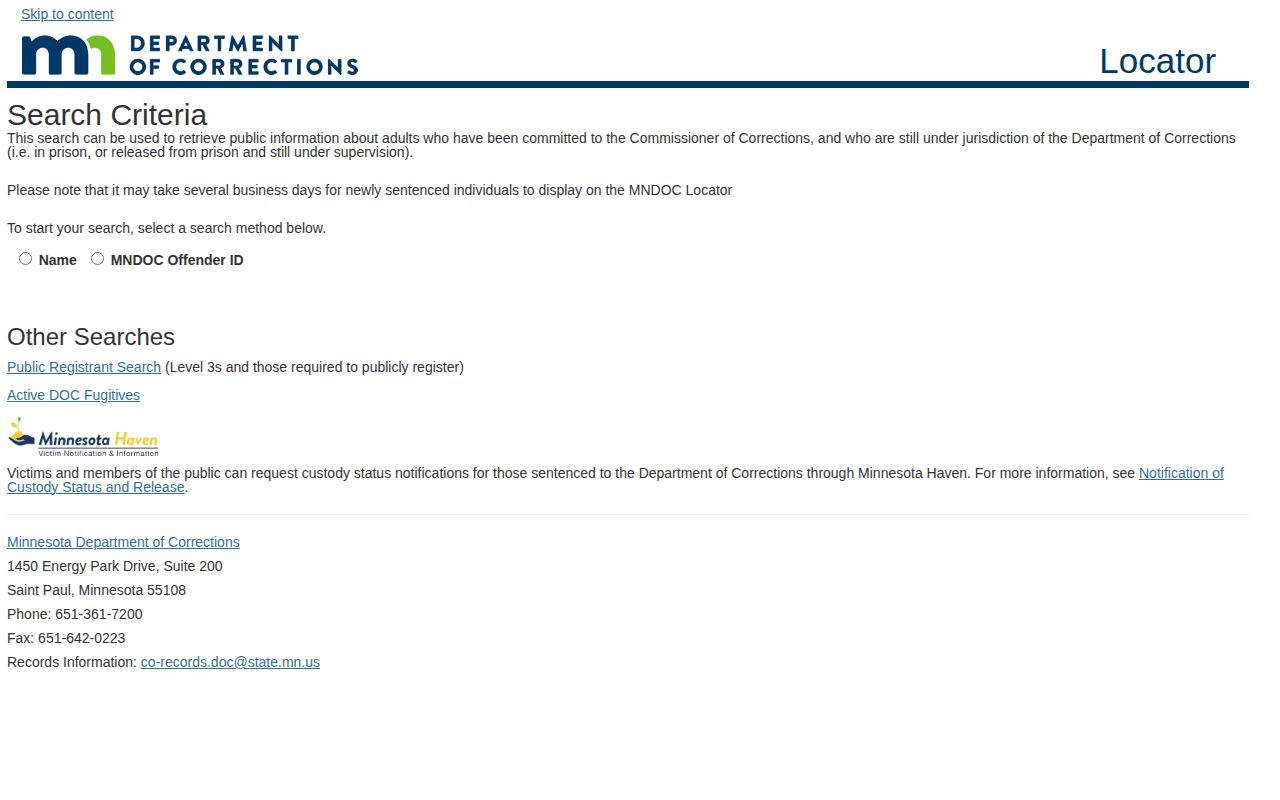
The search result must be read by label and status. A date copied without that context can turn a supervision expiration into a false prison-release date.
Morrison DOC Release Date Labels
The Public Viewer can display different fields depending on the person’s current legal status. Observed labels include MNDOC Offender ID, DOC Name, Also Known As Name, Birth Date, Current Status, a status effective date, Current Facility or supervising jurisdiction, Sentence Date, Anticipated Release Date, Expiration Date, caseworker or agent, highest ranked offense, county, and court file number. Not every record shows every field.
| DOC label | What it means | What it does not prove |
|---|---|---|
| Anticipated Release Date | Current estimate for the end of the prison portion | The exact departure time or end of the whole sentence |
| Under Supervision as of | Prison confinement ended by the effective date and community supervision began | Final discharge or a Morrison Jail release time |
| Expiration Date | Expected end of DOC jurisdiction and sentence authority | The first day outside prison |
| Current Status | The context that controls how all displayed dates are read | A complete history of each custody move |
An already released state prisoner may show “Under Supervision as of” with a supervising district or Community Corrections Act jurisdiction and no longer show an anticipated date. That is a positive status signal. It says the person left prison for supervision, not that the sentence expired.
Morrison Release Credit Rules
Minnesota is not an 85-percent state. For ordinary covered felonies committed on or after August 1, 1993, Minnesota Statutes section 244.101 divides a fixed executed sentence into a minimum imprisonment term equal to two-thirds and a maximum supervised-release term equal to one-third, subject to section 244.05. The community portion is still part of the sentence.
Current earned incentive release credit adds another layer for eligible people. Under section 244.44, credit tied to an individualized rehabilitation plan can reach 17 percent of the total executed sentence. It does not lengthen supervised release, cannot reduce prison time below half of the executed sentence, and may be revoked for facility-rule violations or new criminal acts. Section 244.45 excludes defined groups, including life sentences and specified older sentence categories.
County-jail good time is separate. Section 641.12 supplies the allowance framework and exceptions. The court sentence, jail credit, disciplinary record, and sheriff’s maintained calculation control an individual Morrison County Jail date. Simple arithmetic cannot confirm it.
Note: Credit affects the current computation only when the person and sentence qualify under the law that governs that custody term.
How Minnesota Computes Morrison Release
Minnesota’s two-thirds and one-third framework is the distinctive starting point for a modern executed sentence. The state then applies jail credit, the sentence’s legal terms, disciplinary confinement, eligible earned incentive credit, and any special conditional-release rule. That mix explains why a calendar estimate made from the sentence date may not match the official Anticipated Release Date.
The calculation also changes when the legal record changes. A corrected jail-credit award, amended sentence, new court order, or verified detainer may affect the departure path. Discipline can extend prison confinement into time that would otherwise form part of supervised release. Earned credit can be lost. In a county-jail term, local good-time eligibility and the sheriff’s records control rather than the state prison formula.
For the limited population under the Supervised Release Board, the Board can assign a projected release date or continue the case with directives. Its initial readiness review occurs three years before the minimum term, but no one may be released before minimum eligibility. A hearing date or agenda entry is not a grant of release.
Why Morrison Release Dates Change
A future date remains conditional until the release authority records the event. Some changes affect the length of confinement. Others change where the person goes. A transfer to another county, DOC, federal custody, or immigration custody may occur on the expected county departure date but does not place the person in the community.
| Factor | Possible effect | Verification source |
|---|---|---|
| Jail or earned credit | Can move an eligible estimate earlier under the governing rules | Jail calculation or DOC detail |
| Discipline or credit revocation | Can extend confinement | Custodian or DOC sentence record |
| Detainer or hold | Can lead to transfer instead of community release | Holding agency and receiving agency |
| Court order or corrected credit | Can revise the legal calculation | Court register and custodian |
| Board decision | Can assign a date or continue a board-eligible case | Board minutes and Public Viewer |
| Processing or data lag | Can delay a public update without changing the order itself | Facility records office |
Work release should not be mistaken for final release. It permits approved movement while a custodial sentence continues. Likewise, bond posted in a court record documents a bail event, but another hold can delay the person’s physical departure.
Morrison Weekend Release Date Rules
Minnesota Statutes section 244.05 contains a day-of-release rule that depends on the offense-date category. For the older pre-August 1, 1992 group described in subdivision 1a, a scheduled Friday, weekend, or holiday release moves to the last prior day that is not Friday, a weekend, or a holiday. For crimes on or after that date, such a scheduled release moves to the first later day that is not Friday, a weekend, or a holiday.
This rule must be applied to the correct statutory group. It does not create a universal Friday-release promise, and it should not be used to guess a person’s departure time. Morrison County also publishes no universal hour for jail releases. The official date and event must come from the jail or DOC record.
Holiday movement is one more reason to preserve the offense-date category and the exact official label. A family plan based on a raw calendar can be off even when the starting sentence math was sound.
Confirm Morrison Actual Release Dates
For Morrison County Jail, ask for the maintained booking and release or custody-disposition record. Minnesota law requires the sheriff’s permanent jail record to include when and by what authority the person was liberated. That historical field is stronger than a name vanishing from the current list. Ask whether the event was community release, transfer, or another disposition.
For state prison, read the Public Viewer and contact the relevant facility or DOC central records when the calculation needs explanation. Minnesota Haven can provide eligible state custody and release notifications. Minnesota VINE is the separate county-jail system. The VINELink Check explains how to set a Morrison County Jail alert, but a notice should still be verified with the custodian.
A projected date can support plans. Only the final release record proves the event. Preserve the date label, status, source, and time checked so the result is not detached from the context that gave it meaning.